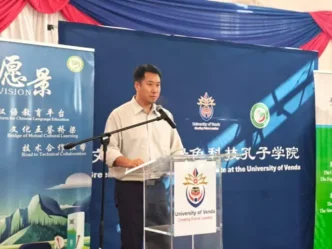
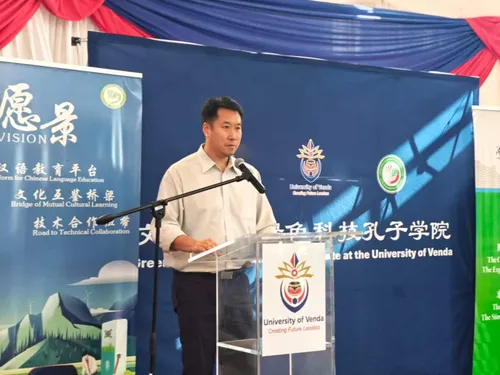
As the world commemorated the 17th United Nations Chinese Language Day, a significant event took place at the University of Venda in South Africa, highlighting the growing cooperation between China and South Africa in the field of technology. The Green Tech Confucius Institute, a unique centre focused on “green technology”, hosted a speech by Zou Song, a journalist from the Africa Center Branch of People’s Daily, who shared his experience reporting on the Square Kilometre Array (SKA) project.
The SKA project, dubbed the “World’s Giant Eye”, is a major scientific initiative involving both China and South Africa, aiming to explore stellar evolution, cosmic origins, and potential extraterrestrial life. As founding SKA members, China and South Africa share core construction and research responsibilities. The project comprises hundreds of dish antennas rooted in South Africa’s radio-silent Karoo Desert, with rows of white antennae standing sentinel in the desert while multinational researchers troubleshoot technical challenges.
Breaking Language Barriers
Language barriers persist in cross-border projects, but China’s primary role in equipment installation necessitates Chinese communication. Consequently, South African technical coordinators have organically acquired Chinese proficiency through collaboration—from jointly reviewing manuals to expressing gratitude in Mandarin. According to the United Nations, language remains a key factor in breaking barriers and fostering international cooperation.
China-SA Cooperation in Tech
The University of Venda’s Confucius Institute is notably distinct as the world’s only “green technology”-focused centre. Beyond language instruction, it serves as a strategic foothold for China-South Africa tech cooperation. In its classrooms, “environmental protection” and “sustainability” are recurring themes; its library prominently features materials on renewable energy and advanced technology. On campus, a small agricultural experimental field has utilised BeiDou satellite receivers for precision farming for more than a year, while a newly established partnership with the Council for Scientific and Industrial Research (CSIR) aims to promote innovation and development in the field of green technology.
Some of the key benefits of China-SA tech cooperation include:
- Promoting sustainable development and environmental protection
- Fostering innovation and entrepreneurship in the field of green technology
- Enhancing bilateral trade and investment between China and South Africa
- Providing opportunities for skills development and knowledge transfer
In conclusion, the growing cooperation between China and South Africa in the field of technology is a significant development that holds great promise for the future. As the world becomes increasingly interconnected, the importance of language in bridging gaps and fostering international cooperation cannot be overstated.