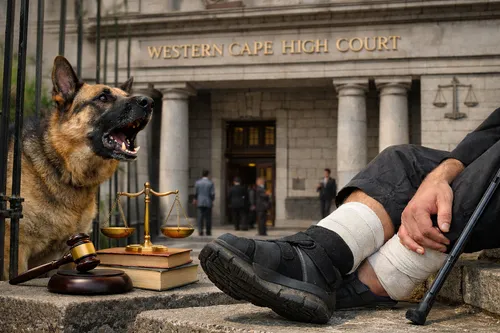
A recent ruling by the Western Cape High Court has cleared dog owner Shaun Errol Bergstedt of liability for a R350 000 ankle injury claim. The court determined that the injury resulted from William Henry Rhode’s own fall after the dog had been secured, and not from the dog attack itself. Bergstedt’s dog had escaped from his property and bitten Rhode on the ankle, causing two puncture wounds. However, Rhode later claimed that the incident also led to a fractured ankle and sought damages.
Legal Causation
The High Court focused on the issue of legal causation, which refers to the connection between the defendant’s actions and the plaintiff’s injury. In this case, the court found that the fracture resulted from Rhode’s own fall after the dog had already been secured. During the trial, Rhode conceded under cross-examination that the fracture was caused by a misstep off a sidewalk rather than by the bite itself.
Despite this concession, the trial court had initially ruled in Rhode’s favour, reasoning that the dog attack set in motion the events that ultimately led to the fall and injury. However, the appeal court found this approach flawed, pointing to two critical issues. Firstly, it held that Rhode had effectively changed his case, and secondly, that the fall was an independent intervening act that was too remote from the dog bite to hold the owner responsible for the fracture.
Implications of the Ruling
The High Court’s ruling has significant implications for dog owners in South Africa. It highlights the importance of establishing a clear connection between the defendant’s actions and the plaintiff’s injury. In this case, the court found that the dog bite caused puncture wounds, but it did not legally cause the fractured ankle. The ruling also underscores the need for plaintiffs to be consistent in their claims and to provide evidence to support their allegations.
According to the Department of Justice and Constitutional Development, the concept of legal causation is a critical aspect of South African law. It requires that the defendant’s actions be the direct cause of the plaintiff’s injury. In this case, the High Court found that the defendant’s actions did not meet this requirement, and therefore, he was not liable for the fractured ankle.
The following are some key takeaways from the ruling:
- The dog owner was cleared of liability for the R350 000 ankle injury claim.
- The court found that the injury resulted from the plaintiff’s own fall after the dog had been secured.
- The ruling highlights the importance of establishing a clear connection between the defendant’s actions and the plaintiff’s injury.
- The concept of legal causation is a critical aspect of South African law.