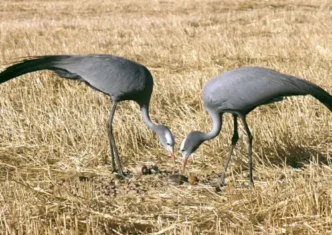
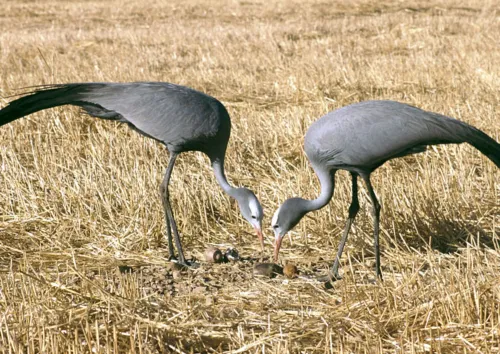
A new study has raised concerns about the future of South Africa’s national bird, the Blue Crane, after researchers found that intensive agricultural landscapes in the Western Cape may be reducing the species’ breeding success. The research, conducted by scientists from the University of Cape Town’s FitzPatrick Institute of African Ornithology and the International Crane Foundation in partnership with the Endangered Wildlife Trust, suggests that parts of the province’s wheat-growing regions could be acting as an “ecological trap” for the birds.
Breeding Patterns Compared
The study found that Blue Cranes breeding in the Western Cape’s wheatlands, particularly in the Overberg and Swartland, are producing significantly fewer chicks than populations in other parts of the country. Researchers compared breeding patterns of Blue Cranes in several regions, including the wheatlands of the Western Cape, the Karoo and the eastern grasslands of South Africa. Their analysis of long-term breeding monitoring data showed that pairs in the Karoo and eastern grasslands produced close to one fledgling per breeding attempt. In contrast, pairs breeding in the Western Cape wheatlands produced roughly half as many chicks.
Conservation Concerns
The study also found fewer successful breeding pairs in the wheat-growing regions. Around two-thirds of pairs in the grasslands and the Karoo raised at least one chick, compared with only about 40% of pairs in the Overberg and Swartland. According to IUCN Red List, the Blue Crane is listed as vulnerable, and the decline in breeding productivity in the Western Cape could have significant implications for the species’ overall population trend.
The research team also analysed winter flocks to estimate how many young birds are joining the population each year. Between 2019 and 2021, juveniles accounted for only about 4% of winter flocks in the Overberg and 3.6% in the Swartland. This is roughly half the proportion recorded about three decades ago, suggesting fewer young cranes are surviving to adulthood.
Some key findings from the study include:
- Blue Cranes in the Western Cape wheatlands produce 50% fewer chicks than those in other regions
- Only 40% of breeding pairs in the Overberg and Swartland raise at least one chick
- Juveniles account for less than 4% of winter flocks in the Overberg and Swartland
As noted by Dr Christie Craig, the study’s lead researcher and a conservation scientist at the International Crane Foundation and Endangered Wildlife Trust, the decline in breeding productivity in the Western Cape could have significant implications for the species’ overall population trend. More information on the Blue Crane can be found on the Wikipedia page for the species.