
U.S. Military Strikes Venezuela, Captures Maduro—But Who’s Actually Running the Country?
In the early hours of Saturday morning, more than 150 U.S. military aircraft descended on Venezuela in what President Donald Trump called “one of the most stunning, effective and powerful displays of American military might and confidence in American history.” By dawn, Venezuelan President Nicolás Maduro and his wife Cilia Flores were in American custody, headed for Manhattan to face drug trafficking charges.
But 48 hours later, the question remains: who’s in charge in Caracas?
The Operation
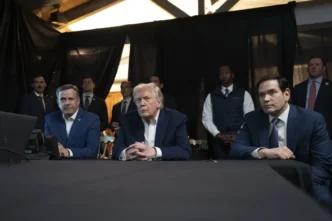
Operation Absolute Resolve began around 2:00 a.m. local time with strikes across northern Venezuela and the capital. U.S. forces had spent months planning the operation, with CIA teams tracking Maduro’s movements and habits—where he slept, what he ate, even details about his pets.
Trump had given Maduro one last chance in a private phone call a week earlier, telling the Venezuelan leader he had to surrender. Maduro refused. Trump gave the final order to proceed at 10:46 p.m. EST on January 2.
The assault lasted less than 30 minutes. At least seven explosions were reported around 2:00 a.m. Venezuelan time. Video verified by news agencies showed tracers lighting up the night sky over Caracas as low-flying aircraft swept through the capital.
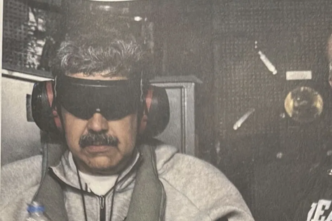
Maduro was captured at Fuerte Tiuna, Venezuela’s largest military complex, where he and his wife were seized at their home. By Saturday afternoon, photos showed him blindfolded and handcuffed aboard the USS Iwo Jima, then walking through DEA headquarters in New York.
The Human Cost
The operation came with a price. Venezuelan officials reported at least 40 people killed, a figure later revised to at least 80 civilians and security members according to senior Venezuelan officials. Defense Minister Vladimir Padrino López said strikes hit civilian neighborhoods including a three-story apartment complex in Catia La Mar.
Trump acknowledged some U.S. forces were injured but said none were killed. He also claimed many Cubans lost their lives protecting Maduro, though he didn’t provide exact numbers.
The Power Vacuum
Here’s where things get complicated.
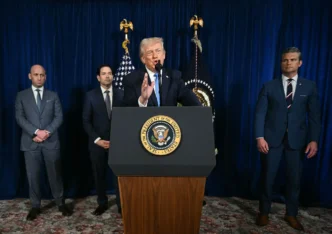
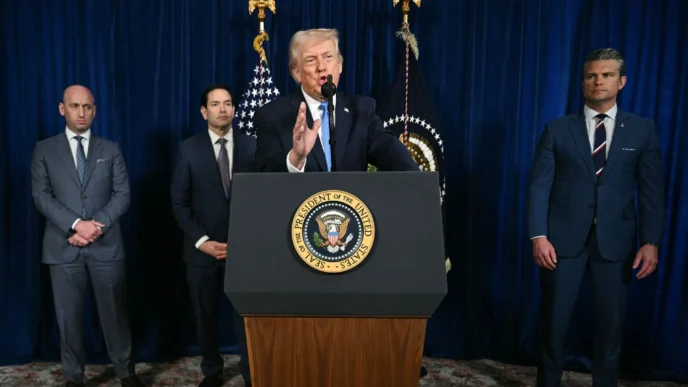
Trump announced that Vice President Delcy Rodríguez had been sworn in as interim president and would cooperate with the U.S. to “run” Venezuela during a transition period. He said Secretary of State Marco Rubio had spoken with her and that she was “essentially willing to do what we think is necessary to make Venezuela great again.”
But Rodríguez had other ideas.
In a televised address surrounded by military leaders, she declared: “There is only one president in this country, and his name is Nicolás Maduro.” She called the U.S. action “barbaric” and demanded proof of life for Maduro and his wife.
Rodríguez later said Venezuela would “never return to being slaves” or “a colony of any empire,” though she left the door open for dialogue based on “respectful relations.”
Rodríguez, 56, has been one of the most powerful figures in the chavista system since the days of Hugo Chávez. She served as foreign minister, led the Constituent National Assembly, and most recently held dual roles as vice president and minister of both finance and petroleum. Policy analysts describe her as “not a moderate alternative to Maduro” but rather “one of the most powerful and hard-line figures in the entire system.”
Adding to the confusion, multiple sources report Rodríguez may actually be in Russia, though other reports place her in Caracas. Her exact whereabouts remain unknown.
The Opposition Gets Sidelined
Perhaps most surprising was Trump’s treatment of Venezuela’s democratic opposition.
Opposition leader María Corina Machado, who won the 2025 Nobel Peace Prize, celebrated the operation as the “hour of freedom” and called for Edmundo González Urrutia—widely believed to have won the July 2024 election—to assume the presidency.
But Trump dismissed her. “I think it would be very tough for her to be the leader,” Trump said. “She doesn’t have the support within or the respect within the country.”
This caught many by surprise. Machado had publicly supported Trump, even dedicating her Nobel Prize to him. Independent exit polls showed González Urrutia received two-thirds of the votes in 2024, and the U.S. previously said “overwhelming evidence” supported his victory.
Yet Trump made clear he plans to work with Rodríguez, a Maduro loyalist sanctioned by the U.S. government, rather than the democratic opposition his administration had previously backed.
What Comes Next
Maduro is scheduled to appear in Manhattan federal court on January 5 to face narco-terrorism charges that supersede a 2020 indictment. Attorney General Pam Bondi promised he would “face the full wrath of American justice on American soil in American courts.”
Meanwhile in Venezuela, the streets of Caracas remained quiet on Sunday. Convenience stores, gas stations and other businesses were mostly closed as residents stocked up on supplies, uncertain what comes next.
The U.S. Federal Aviation Administration prohibited American aircraft from operating in Venezuelan airspace, citing “ongoing military activity.” The embassy issued shelter-in-place orders for Americans in the country.
Key Maduro allies remain in power, including Defense Minister Vladimir Padrino López and Interior Minister Diosdado Cabello—both targeted in the same indictment as Maduro. Padrino López announced the armed forces had been activated to “guarantee sovereignty” and said much of Maduro’s security team was killed in the operation.
Trump indicated the U.S. might send troops to Venezuela as part of running the country during transition, though details remain unclear. Senator Mike Lee said Rubio “anticipates no further action in Venezuela now that Maduro is in US custody.”
International Fallout
The operation has drawn sharp international reactions.
Russia’s Foreign Ministry condemned what it called a U.S. “act of armed aggression” and called for an emergency U.N. Security Council meeting. The Security Council, acting on an emergency request from Colombia, planned to hold a meeting on Monday morning.
Democratic Senator Mark Warner raised concerns about precedent: “Does this mean any large country can indict the ruler of a smaller adjacent country and take that person out?”
Legal experts immediately questioned the operation’s legality. The Trump administration did not notify Congress in advance, citing concerns it could endanger the mission. Republican lawmakers defended it as a law enforcement action with military support, for which the president has “inherent constitutional authority.”
The operation came exactly 36 years after the U.S. invasion of Panama that led to the capture of Manuel Noriega—another Latin American leader seized to face drug charges in American courts.
The Bottom Line
Trump declared the U.S. would “run the country until such time as we can do a safe, proper and judicious transition.” He emphasized getting American oil companies into Venezuela to access its vast petroleum reserves.
But with Rodríguez defying U.S. expectations, the democratic opposition sidelined, Maduro’s military and political apparatus still largely intact, and international condemnation mounting, the question remains: what does “running” Venezuela actually mean?