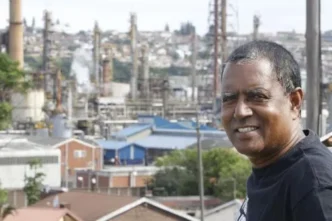
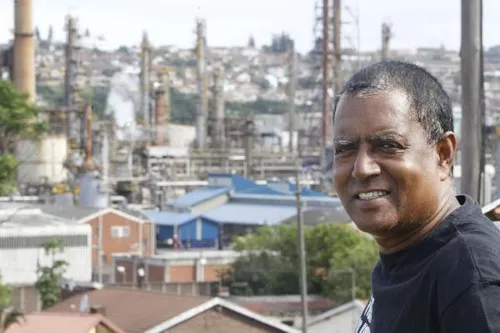
The South Durban Community Environmental Alliance (SDCEA) has expressed opposition to the reopening of the flood-damaged Sapref crude oil refinery in Durban, citing concerns over the plant’s legacy environmental and social damage. Instead, SDCEA leader Desmond D’sa believes the plant and the nearby Engen refinery in Durban should be decommissioned and the area rehabilitated.
Calls to urgently reopen South Africa’s largest oil refinery, Sapref, now under the South African National Petroleum Company (SANPC), reflect a troubling continuity in the country’s energy governance: short-term energy security concerns are once again being prioritised over long-term environmental accountability. The push by Minerals and Petroleum Resources Minister Gwede Mantashe to restore refining capacity is framed around stabilising fuel supply and prices. While this is a legitimate concern, it obscures a far more pressing issue, one that remains unresolved despite years of public scrutiny: Who is responsible for the legacy environmental and social damage associated with Sapref in South Durban?
Legacy of Pollution
The Department of Environment, Forestry and Fisheries has previously raised concerns over the environmental impact of the refinery. The risk now is that the South African state, through SANPC and the CEF, has inherited a contaminated asset without ensuring that those responsible for decades of pollution have met their obligations. If so, the burden of environmental remediation is being shifted away from multinational corporations and onto taxpayers, and, more critically, onto the communities who continue to live with the consequences.
This is particularly concerning in South Durban, and especially in the Island View precinct – the new site targeted for the Sapref reopening, where fuel storage and distribution infrastructure is being expanded as part of a broader strategy to strengthen energy security. This is not a neutral industrial zone. It is an already overburdened pollution hotspot, shaped by decades of petrochemical activity. Communities in areas such as Merebank and Wentworth have long been exposed to cumulative environmental and health risks. Air pollution, soil contamination, and repeated industrial incidents are part of everyday life.
Consequences of Reopening
The 2022 KwaZulu-Natal floods exposed infrastructure failures at Sapref, leading to significant oil spills that contaminated beaches, residential areas, and sensitive ecosystems. Against this backdrop, calls to reopen Sapref, without first addressing its environmental legacy, are deeply problematic. Some of the key concerns include:
- Air pollution: The refinery’s operations will continue to release harmful pollutants into the air, exacerbating respiratory problems and other health issues.
- Soil contamination: The refinery’s activities will continue to contaminate the soil, posing a risk to local ecosystems and human health.
- Water pollution: The refinery’s operations will continue to release harmful chemicals into the water, posing a risk to aquatic life and human health.
As the United Nations Environment Programme notes, the environmental impact of industrial activities can have far-reaching consequences for both human health and the environment. It is essential that the South African government prioritises environmental accountability and ensures that those responsible for the legacy environmental and social damage associated with Sapref are held accountable.