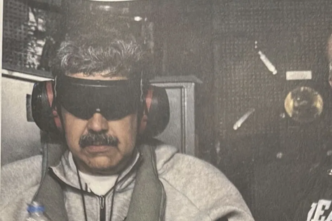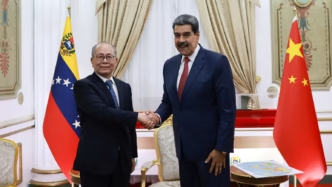

Hours before U.S. forces snatched Nicolás Maduro from his bedroom, the Venezuelan president was posing for photos with China’s top envoy to Latin America, thanking President Xi Jinping for his “brotherhood, like an older brother.”
By Saturday morning, Maduro was in American custody and China was staring at a harsh reality: it had just lost one of its staunchest partners in Latin America. Beijing’s response has been swift condemnation—but on Chinese social media, many see something else entirely: a template for taking Taiwan.
China’s Venezuela Setback
China and Venezuela forged close relations over decades, united by shared political ideology and mutual distrust of U.S.-led global order. China became Venezuela’s largest crude oil buyer and biggest creditor, lending the country $62.5 billion since 2007—nearly half of all Chinese lending to South America and making Venezuela the single largest recipient of Chinese finance worldwide.
Trump’s capture of Maduro threatens that relationship. Questions now swirl about China’s preferential access to Venezuelan oil and its political influence across Latin America.
Beijing issued a strong rebuke Saturday, calling the operation “hegemonic acts” that violated international law and threatened regional peace. The foreign ministry said it was “deeply shocked by and strongly condemns the U.S.’s blatant use of force against a sovereign state.”
Social Media Excitement
While official China condemned the action, Chinese social media erupted with a different reaction: excitement.
By Monday, topics linked to Maduro’s capture received over 650 million impressions on Weibo, China’s X-like platform. Many users suggested the operation offered a blueprint for Beijing’s potential military takeover of Taiwan.
“The arrest of the Venezuelan president set a good example for us. Taiwan’s William Lai must be trembling in fear now!” read one popular comment, referring to Taiwan’s president.
If the U.S. can snatch a leader in their backyard, many asked, why can’t China do the same?
Why Taiwan Is Different
Experts say the comparison falls apart under scrutiny.
“China is not the US, and Taiwan is not Venezuela,” said Wang Ting-yu, a Taiwanese lawmaker on the legislature’s foreign affairs and defense committee. “Comparisons that China can carry out the same thing in Taiwan is wrong and inappropriate.”
The capabilities gap matters most. Taiwan sits just 100 miles from mainland China but is protected by treacherous waters and defended by a well-equipped military backed by potential U.S. intervention. Venezuela had none of those advantages.
“China has never been short of hostility towards Taiwan militarily; what it lacks is feasible means,” Wang explained.
Taiwan also differs fundamentally from Venezuela: it’s a functioning democracy with free elections, not an isolated authoritarian regime led by someone facing international criminal charges. Taiwan has powerful allies and advanced defenses. Venezuela had neither.
What China Gains
Rather than inspiring a Taiwan invasion, experts say China will exploit the Venezuela operation diplomatically.
Beijing can now position itself as the responsible global superpower defending international law while America acts as the world’s policeman, disregarding sovereignty when convenient.
“The US operation essentially allows China to position itself as a stabilizing force upholding the international order,” said Zhou Bo, a retired People’s Liberation Army senior colonel.
Ryan Hass, director of Brookings’ John L. Thornton China Center, noted that China will “emphasize to Washington it expects to be given the same latitude for great power exemptions to international law that the U.S. takes for itself”—particularly in the South China Sea, which China claims virtually in its entirety.
“Beijing will be more focused on protecting its interests, condemning US actions, and sharpening the contrast with the US in the international system than it will be on drawing inspiration from today’s events to alter its approach on Taiwan,” Hass wrote.
The Oil Impact
Despite losing a political ally, China’s oil supply faces minimal disruption. Venezuela’s crude output has fallen by two-thirds from its peak to around one million barrels daily—modest compared to China’s massive energy needs.
Most Chinese importers of Venezuelan crude are small independent refiners drawn to the oil because of steep discounts. Trump suggested China could continue buying Venezuelan crude at reduced volumes.
Taiwan Shrugs
In Taiwan, officials are downplaying fears of Chinese aggression inspired by Venezuela.
“Democracy, alliances, capabilities, and the rule of law—Taiwan is completely different from Venezuela,” said one Taiwanese official. “To deliberately equate the two is nothing but misleading.”
Taiwan just endured Chinese military exercises last week that simulated a blockade—long before the Venezuela operation. Beijing’s hostility toward the island isn’t new, and one U.S. military action in Latin America won’t change China’s long-term calculus.
The Real Question
The Venezuela operation may not inspire China to invade Taiwan, but it raises uncomfortable questions about international norms.
If great powers can seize leaders they consider illegitimate, what rules remain? If the U.S. invokes spheres of influence in its hemisphere, can China claim the same in Asia?
For now, China has lost an ally but gained diplomatic ammunition. And on Chinese social media, millions are watching—and wondering what comes next.