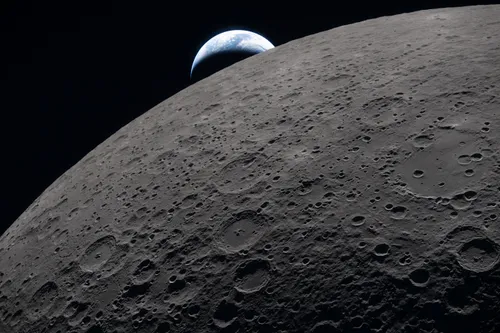
Astronauts on NASA’s Artemis II mission witnessed a historic event during their lunar flyby, spotting six meteorite strikes on the moon’s surface. The crew, led by mission commander Reid Wiseman, observed the strikes during their nearly seven-hour observation period, with Canadian crew member Jeremy Hansen describing the flashes as “pinpricks of light” that lasted for only a millisecond.
According to NASA, the majority of the sightings took place during a solar eclipse, when the moon passed in front of the Sun. The team’s observations have piqued the interest of scientists, who are now working to match the data with information from a satellite orbiting the moon. As NASA continues to study the phenomenon, experts are weighing in on the significance of the findings.
Meteorite Strikes and Lunar Science
The meteorite strikes observed by the Artemis II crew are a rare phenomenon, with scientists eager to learn more about the frequency and size of the projectiles. Bruce Betts, chief scientist at the Planetary Society, notes that the descriptions provided by the astronauts will allow scientists to “get some idea of the frequency of impact” as well as the size of the projectiles. One question on everyone’s mind is what size an object needs to be to create a flash visible to the astronauts.
Implications for Future Lunar Missions
The observations raise important questions about the daily flux of meteors and the potential risks associated with establishing a lunar base. Peter Schultz, Professor Emeritus of Geological Sciences at Brown University, suggests that the “daily flux of meteors should be monitored more closely in the future before a lunar base is established.” As scientists continue to study the data, the Artemis II mission is providing valuable insights into the lunar environment and the challenges that come with space exploration.
Here are some key facts about the meteorite strikes observed during the Artemis II mission:
- A total of six meteorite impacts were reported by the crew
- The majority of the sightings took place during a solar eclipse
- The flashes were described as “pinpricks of light” that lasted for only a millisecond
- The size of the projectiles is still unknown, but experts believe they are larger than a piece of dust and smaller than a meter-size boulder