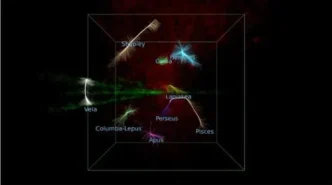
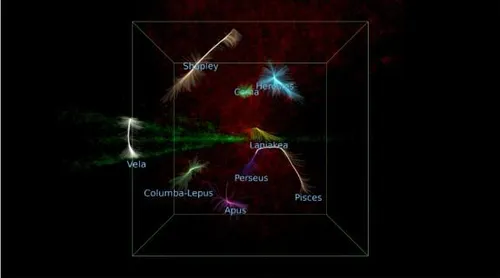
Astronomers have made a groundbreaking discovery, unveiling the Vela-Banzi supercluster, a monumental cosmic structure hidden behind the Milky Way. This revelation carries profound implications for our understanding of cosmic dynamics and introduces a novel hybrid approach to future astronomical explorations.
The region, known as the ‘Zone of Avoidance,’ has posed a significant challenge for astronomers; it covers approximately 20% of the sky and is obscured by the dense disk of the Milky Way. For decades, this blind spot has thwarted efforts to gain a comprehensive understanding of the large-scale structure of the Universe, particularly the origin of vast cosmic flows — the large-scale movements of galaxies driven by gravitational forces.
Vela-Banzi Supercluster Discovery
To decode the mystery behind the Zone of Avoidance, an international team of researchers has crafted an innovative hybrid reconstruction technique. This groundbreaking method merges two types of galaxy measurements: galaxy redshifts, which reveal how rapidly galaxies are receding from us as the Universe expands, and galaxy distances along with their peculiar velocities, illustrating the gravitational interactions over vast cosmic expanses. This combination enables the reconstruction of the hidden mass distribution, including the elusive dark matter.
Employing over 65,000 galaxy distance measurements from the CosmicFlows catalogue and adding more than 8,000 new galaxy redshifts captured close to the Milky Way’s plane, the researchers made a pivotal breakthrough. The Southern African Large Optical Telescope (SALT) and the MeerKAT radio telescope — one of the world’s most powerful radio arrays — played critical roles. MeerKAT’s ability to detect hydrogen gas at radio wavelengths allowed it to penetrate the thick clouds of dust within the Zone of Avoidance, unveiling previously obscured galaxies.
Key Findings
This pioneering research has unveiled the startling reality that the Vela Supercluster is not only far more expansive than previously estimated, but also extraordinarily dense. Situated approximately 800 million light-years from Earth, this astronomical marvel stretches across 300 million light-years and is believed to contain an astonishing amount of matter, equivalent to around 30 million billion Suns (approximately 3 × 10^16 solar masses).
The Vela Supercluster, now known affectionately as ‘Vela-Banzi’ — a term derived from isiXhosa meaning ‘revealing widely’ — challenges the dominance of the famed Shapley Supercluster as the most massive structure nearby. Vela’s intricate internal composition reveals two main dense cores that are gradually converging, highlighting the complexity of this remarkable cosmic entity. Its gravitational influence consequently surpasses that of other well-known cosmic structures.
Some key features of the Vela-Banzi supercluster include:
- A vast network of galaxies, galaxy clusters, and superclusters
- A complex internal structure, with two main dense cores
- An enormous amount of matter, equivalent to around 30 million billion Suns
- A significant impact on our understanding of cosmic dynamics and the large-scale structure of the Universe
As researchers continue to study the Vela-Banzi supercluster, they may uncover even more secrets about the Universe and its many mysteries. For more information on the CosmicFlows project, visit the National Research Foundation website.