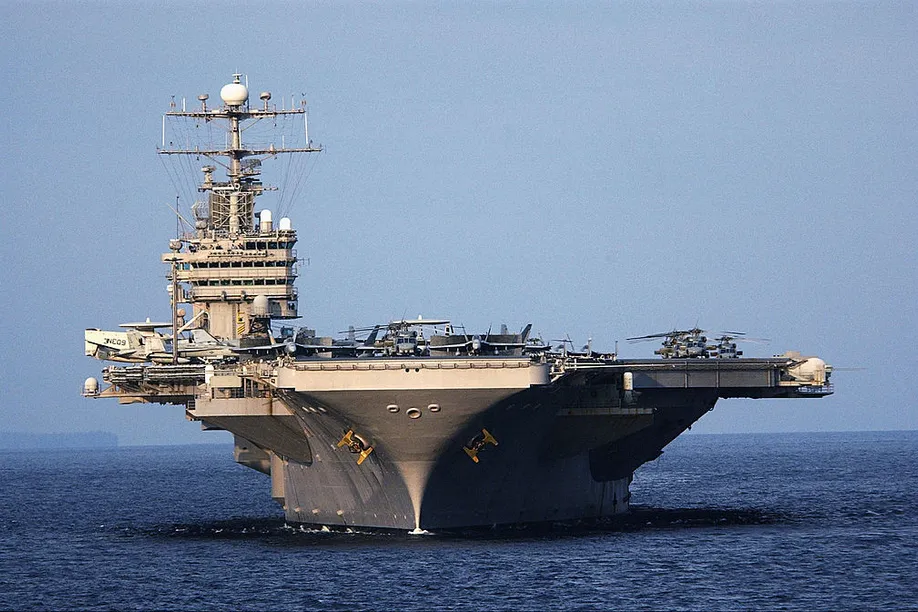
WASHINGTON D.C. — In a move that has sent ripples through global energy markets and put Middle Eastern capitals on high alert, President Donald Trump has announced a significant escalation in military posturing against Tehran. Invoking a familiar “maximum pressure” rhetoric, the President confirmed on Friday that a formidable naval armada is currently steaming toward the Middle East, a deployment he framed as a direct response to recent Iranian provocations.
The announcement, delivered with the characteristic bluntness that has come to define his second term’s foreign policy, serves as a sharp departure from the previous administration’s diplomatic caution.
A Return to Brinkmanship
“Iran has been looking for trouble, and we are going to give them exactly what they want if they don’t change course,” the President told reporters at the White House. While specific vessel names were not disclosed, military analysts suggest the deployment includes at least one carrier strike group and several guided-missile destroyers.
The President’s “armada” rhetoric echoes his 2017 standoff with North Korea, a tactic designed to project overwhelming force to compel a diplomatic retreat. However, the stakes in 2026 are arguably higher, with the Strait of Hormuz—the world’s most vital oil chokepoint—sitting directly in the crosshairs of any potential kinetic conflict.
The Intelligence Trigger
The surge follows classified briefings regarding what the administration describes as “credible threats” to U.S. assets and commercial shipping in the Persian Gulf. Tensions have simmered since the turn of the year, as Tehran signaled an acceleration of its nuclear enrichment program and increased support for regional proxies.
For South Africans and the broader African continent, the move is more than just a distant geopolitical skirmish. Any disruption to Gulf shipping traditionally leads to a spike in Brent Crude prices, which filters down to South African petrol pumps and food inflation almost instantly.
Global Reactions and Market Fallout
The reaction from the international community has been swift:
- The Markets: Oil prices jumped 3.4% following the news, as traders braced for potential supply disruptions.
- Tehran’s Response: Iranian officials dismissed the move as “psychological warfare,” asserting their right to defend their territorial waters.
- The Pentagon: Defense officials have maintained a disciplined silence, though sources confirm the fleet movement is intended to “re-establish deterrence.”
The “America First” Calculus
Critics argue that the deployment risks an accidental slide into an uncontainable war, while supporters see it as a necessary correction to what they perceive as years of American passivity. By moving a “massive” naval presence into the region, the President is signaling that his “America First” doctrine includes a heavily armed presence in zones where U.S. economic interests are at risk.
As the fleet nears the Arabian Sea, the world watches to see if this is a prelude to a new round of negotiations or the opening salvo of a much deeper confrontation. In the high-stakes game of Middle Eastern chess, the U.S. has just moved its most powerful pieces to the center of the board.
Source Credit: This report is based on coverage by Bloomberg News and White House press briefings.